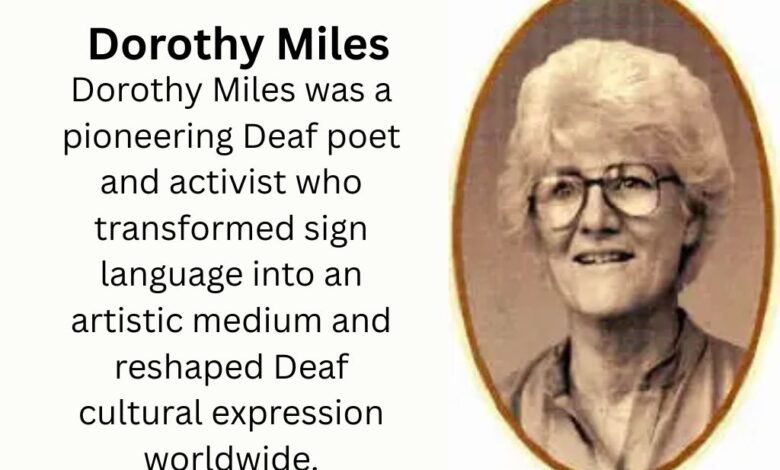
Dorothy Miles (1931–1993) stands as one of the most influential figures in the history of Deaf culture, sign language literature, and performance poetry. A Welsh-born poet, playwright, educator, and activist, she helped transform sign language from a practical communication tool into a recognized artistic and literary form. Her work bridged communities, languages, and cultures, leaving a legacy that continues to inspire Deaf artists and educators around the world.
This article explores her life journey, artistic achievements, activism, and lasting influence on Deaf identity and sign language poetry.
Early Life and the Onset of Deafness
Dorothy Miles was born on August 19, 1931, in Wales. Her early childhood was shaped by a hearing world, but her life changed dramatically when she lost her hearing at a young age after contracting meningitis. This sudden transition placed her within the Deaf community during a period when sign language was often discouraged in education systems.
Like many Deaf children of her time in the United Kingdom, Miles was educated in schools that emphasized speech training and lip-reading over sign language. This approach often limited full communication and expression for Deaf students. However, Miles demonstrated strong academic ability and a deep appreciation for language, especially poetry and written English. This early fascination with words would later become central to her artistic identity.
Education and Growth as a Writer
Miles’ intellectual curiosity and talent eventually led her to the United States, where she enrolled at Gallaudet University—a world-renowned university dedicated to Deaf and hard-of-hearing students.
At Gallaudet, she encountered a vibrant Deaf community that actively used American Sign Language (ASL). This environment was transformative. For the first time, she experienced a culture where visual language was not only accepted but celebrated as a full linguistic system.
During her time at Gallaudet, Miles developed her skills in writing, drama, and performance. She began experimenting with blending written poetry and sign language, exploring how rhythm, movement, and facial expression could carry poetic meaning in a visual form. This experimentation laid the foundation for her later groundbreaking work in sign language poetry.
Career and Work with the National Theatre of the Deaf
One of the most significant stages of Miles’ career was her involvement with the National Theatre of the Deaf (NTD), an innovative performing arts company founded to showcase Deaf performers and integrate sign language into theatrical performance.
At the NTD, Miles worked as a performer, writer, and interpreter. She contributed to productions that combined spoken English, ASL, and expressive movement, making performances accessible to both Deaf and hearing audiences.
Her role in the company was crucial in shaping how sign language could function theatrically—not just as translation, but as a primary artistic medium. She helped demonstrate that sign language could convey humor, emotion, rhythm, and poetic depth in ways that spoken language could not always replicate.
The Birth of Modern Sign Language Poetry
Dorothy Miles is widely regarded as a pioneer of modern sign language poetry, a form of artistic expression that uses the visual-spatial nature of sign languages to create poetic works.
Unlike spoken poetry, sign language poetry relies on:
- Handshape and movement
- Facial expressions
- Body rhythm and spatial structure
- Visual metaphor and storytelling
Miles explored how ASL and British Sign Language (BSL) could be used not only for communication but for aesthetic expression. She wrote and performed poems that existed simultaneously in written English and sign language form.
Her work helped establish the idea that sign languages are not translations of spoken languages, but complete linguistic systems capable of independent artistic creation.
Some of her poetry focused on Deaf identity, communication barriers, and the beauty of visual language. She often emphasized emotional clarity and accessibility, ensuring that both Deaf and hearing audiences could engage with her work.
Contributions to Deaf Education and Advocacy
Beyond her artistic achievements, Miles was deeply committed to improving Deaf education and awareness. She worked as an educator and advocate in both the United States and the United Kingdom.
Her advocacy focused on several key ideas:
1. Recognition of Sign Language
Miles argued that sign languages should be recognized as full languages rather than simplified communication systems. This perspective was important during a time when many educational institutions discouraged sign use.
2. Cultural Identity for Deaf People
She promoted the idea that Deaf individuals form a cultural and linguistic community, not merely a group defined by hearing loss. This view contributed to the modern understanding of Deaf culture.
3. Inclusive Communication
Miles believed that communication between Deaf and hearing people should be mutually respectful and accessible. She encouraged the use of interpreters and bilingual education systems.
Her work helped shape early frameworks for Deaf awareness programs and educational materials in both BSL and ASL contexts.
Return to the United Kingdom and Later Work
After her time in the United States, Miles returned to the United Kingdom in the late 1970s. She continued her work as a writer, educator, and advocate, contributing to the development of Deaf media and educational initiatives.
During this period, she became involved in early television and public education projects aimed at raising awareness of Deaf issues. She also contributed to the development of teaching materials for British Sign Language, which at the time was still struggling for recognition as a legitimate language.
Her later years were marked by continued artistic exploration and teaching, though she faced personal and health challenges. Despite this, she remained committed to promoting Deaf culture and sign language arts.
Legacy and Cultural Impact
Dorothy Miles passed away in 1993, but her influence continues to shape Deaf literature, performance art, and education.
Her legacy can be seen in several key areas:
1. Sign Language Poetry Movement
She is considered one of the foundational figures in sign language poetry. Modern Deaf poets and performers continue to build upon the artistic structures she helped establish.
2. Recognition of Sign Languages
Her advocacy contributed to the growing recognition of ASL and BSL as full languages, influencing educational policies and linguistic research.
3. Inspiration for Deaf Artists
Miles inspired generations of Deaf writers, performers, and educators to explore creative expression through sign language.
4. Cultural Recognition
Her contributions have been honored in various ways, including commemorations in Wales and international recognition within Deaf studies communities. She has also been featured in modern tributes celebrating her role in linguistic and cultural history.
Artistic Philosophy and Influence
At the heart of Miles’ work was a simple but powerful idea: language is not limited to sound. She believed that human expression could take multiple forms—spoken, written, and visual—and that each form carried its own beauty and power.
Her poetry often emphasized:
- Emotional clarity
- Visual storytelling
- The unity of movement and meaning
- The dignity of Deaf expression
This philosophy helped reshape how educators, linguists, and artists view sign languages today.
Conclusion
Dorothy Miles remains a towering figure in the history of Deaf culture and linguistic art. Her pioneering work in sign language poetry, her advocacy for Deaf education, and her contributions to theater and cultural identity helped redefine what language and literature can be.
She did not simply translate poetry into sign language—she expanded poetry itself into a new visual dimension. Through her creativity and activism, she gave voice—through movement—to a community that had long been misunderstood.
Today, her legacy continues to resonate in classrooms, theaters, and Deaf communities around the world, reminding us that language is not confined to sound but lives in expression, movement, and human connection.