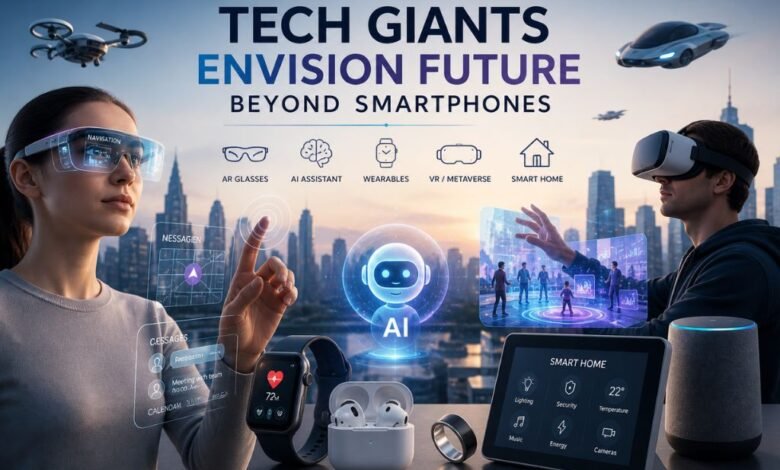
For over a decade, smartphones have been the centerpiece of the digital world—powerful, portable devices that reshaped communication, entertainment, and productivity. Yet today, some of the world’s most influential technology companies are preparing for what comes next. The phrase “Tech Giants Envision Future Beyond Smartphones” reflects a growing consensus across the industry: the smartphone era, while not ending, is approaching maturity. Innovation is now shifting toward new platforms that promise deeper integration into everyday life.
This transformation is being led by companies like Apple Inc., Google LLC, Microsoft, Meta Platforms, and Samsung Electronics. Each is investing billions into emerging technologies such as augmented reality (AR), virtual reality (VR), artificial intelligence (AI), wearable devices, and ambient computing systems. Together, these innovations point toward a future where smartphones are no longer the primary gateway to the digital world.
The Plateau of Smartphone Innovation
The global smartphone market has reached a point of saturation. Hardware improvements—such as better cameras, faster processors, and longer battery life—continue, but they are increasingly incremental. Consumers are holding onto devices longer, and upgrade cycles are slowing.
From a technological standpoint, smartphones are nearing their physical limits. Screen sizes can only grow so much, battery technology has constraints, and the rectangular slab design has remained largely unchanged. As a result, tech giants are looking beyond the smartphone to discover the next major computing platform.
The Rise of Wearable Technology
One of the most immediate successors to smartphones is wearable technology. Devices such as smartwatches, fitness trackers, and smart glasses are already gaining traction. Companies are investing heavily in making these devices more powerful, independent, and seamlessly connected.
For example, Apple Inc. has expanded its ecosystem with the Apple Watch and AirPods, transforming them into essential companions to the iPhone. Meanwhile, Samsung Electronics continues to develop advanced wearables with health monitoring and connectivity features.
Wearables represent a shift toward “always-on” technology—devices that are constantly with the user, collecting data and providing real-time insights. In the future, these devices may reduce the need to frequently check a smartphone, instead delivering information directly through subtle notifications or voice interactions.
Augmented Reality and Smart Glasses
Augmented reality is widely considered one of the most promising technologies in the post-smartphone era. AR overlays digital information onto the physical world, creating a blended experience that enhances how we interact with our surroundings.
Companies like Meta Platforms and Google LLC are actively developing AR glasses that could eventually replace smartphones for many tasks. These glasses would allow users to send messages, navigate maps, attend virtual meetings, and access information without ever taking out a phone.
Similarly, Apple Inc. is rumored to be working on its own AR ecosystem, potentially integrating it deeply with its existing hardware and software platforms.
The vision is clear: instead of looking down at a screen, users will interact with digital content directly in their field of view. This could fundamentally change how people work, learn, and socialize.
Virtual Reality and the Metaverse
While AR enhances the real world, virtual reality creates entirely new digital environments. VR has gained momentum through gaming, but its potential extends far beyond entertainment.
Meta Platforms has been particularly vocal about its vision of the “metaverse”—a persistent, shared virtual space where people can interact, work, and play. VR headsets are becoming more advanced, offering higher resolution, better motion tracking, and more immersive experiences.
In a future where VR becomes mainstream, smartphones may become secondary devices. Instead of scrolling through apps, users could step into virtual spaces where digital experiences are fully interactive and immersive.
Artificial Intelligence as the New Interface
Artificial intelligence is another key driver in the move beyond smartphones. AI is transforming how users interact with technology, shifting from touch-based interfaces to voice, gesture, and predictive systems.
Companies like Google LLC and Microsoft are integrating AI into nearly every aspect of their ecosystems. Voice assistants, smart recommendations, and automation tools are making technology more intuitive and less dependent on manual input.
In the future, AI could act as a personal digital assistant that anticipates needs, manages tasks, and delivers information proactively. This would reduce reliance on traditional smartphone interfaces, allowing users to interact with technology more naturally.
Ambient Computing: Technology That Fades Into the Background
One of the most transformative concepts emerging from tech giants is ambient computing. This idea envisions a world where technology is embedded seamlessly into the environment, rather than confined to a single device.
Imagine a home where lights, speakers, displays, and appliances are all interconnected and responsive. You could ask a question aloud and receive an answer from the nearest device, or walk into a room and have it automatically adjust to your preferences.
Google LLC has been a strong advocate for this approach, developing smart home devices that work together as part of a unified ecosystem. Similarly, Amazon (though not mentioned earlier, also relevant) has expanded its Alexa-powered devices to create a connected home experience.
In this scenario, the smartphone becomes just one of many access points, rather than the central hub.
The Role of Cloud Computing and Edge Technology
The shift beyond smartphones is also being enabled by advancements in cloud computing and edge technology. These systems allow data processing to happen remotely or closer to the user, reducing the need for powerful hardware in a single device.
Microsoft and Google LLC are leading the charge in cloud infrastructure, enabling seamless access to data and applications across multiple devices.
This means future devices—whether they are glasses, wearables, or smart home systems—can be lighter, more efficient, and more interconnected. The heavy lifting is done in the cloud, allowing users to access powerful capabilities from virtually anywhere.
Challenges in Moving Beyond Smartphones
Despite the excitement, the transition away from smartphones is not without challenges.
1. User Adoption
Smartphones are deeply ingrained in daily life. Convincing users to adopt new devices and interfaces will require clear advantages and seamless experiences.
2. Privacy Concerns
Technologies like AR glasses and ambient computing raise significant privacy issues. Constant data collection and real-time monitoring could lead to concerns about surveillance and data security.
3. Technical Limitations
Battery life, processing power, and connectivity remain critical hurdles. For example, AR glasses must be lightweight yet powerful enough to deliver real-time experiences.
4. Ecosystem Integration
For a post-smartphone future to succeed, devices must work together seamlessly. This requires collaboration and standardization across companies—something that has historically been challenging.
The Transition Period: Coexistence, Not Replacement
It’s important to note that smartphones are not disappearing anytime soon. Instead, the industry is entering a transition period where smartphones coexist with emerging technologies.
In the near future, smartphones will likely serve as central hubs that connect and manage other devices. Over time, as new technologies mature, their reliance on smartphones may decrease.
This gradual shift mirrors past transitions in technology—from desktops to laptops, and from laptops to smartphones. Each new platform builds on the previous one rather than replacing it overnight.
What This Means for Consumers
For consumers, the future beyond smartphones promises more personalized, immersive, and convenient experiences.
- Greater convenience: Technology becomes more intuitive and accessible
- Enhanced experiences: AR and VR offer new ways to interact with content
- Improved productivity: AI-driven tools streamline tasks and workflows
- Health and wellness: Wearables provide real-time health insights
However, it also requires adapting to new ways of interacting with technology—moving from screens and taps to gestures, voice commands, and immersive environments.
Conclusion
The vision of “Tech Giants Envision Future Beyond Smartphones” is not just a speculative idea—it is an active transformation already underway. With advancements in AR, VR, AI, wearables, and ambient computing, the tech industry is redefining what it means to connect with the digital world.
While smartphones will remain relevant for years to come, their dominance is gradually being challenged by a new generation of devices and experiences. The future is not centered around a single device but a network of interconnected technologies that work together seamlessly.
As innovation continues, the question is no longer whether we will move beyond smartphones—but how quickly this transformation will unfold and what shape it will ultimately take.