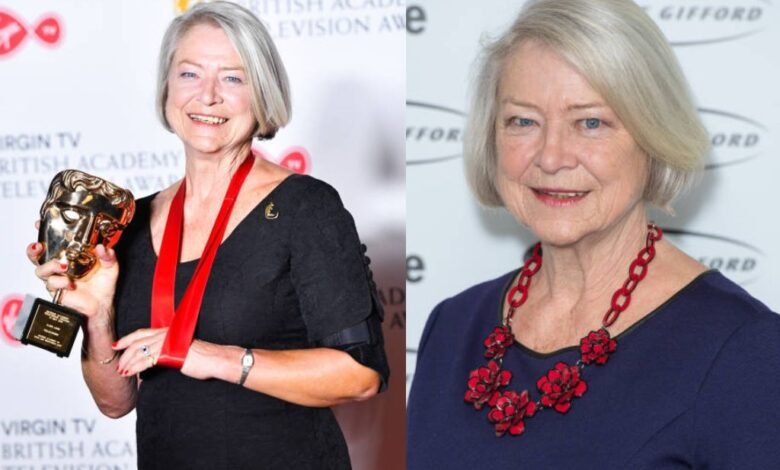
Kate Adie is widely regarded as one of the most influential broadcast journalists of the late 20th century. Known for her fearless presence in conflict zones and her calm, authoritative reporting style, she became a defining figure in war journalism during her long career with the BBC. From covering global conflicts to reporting live during terrorist sieges, Adie reshaped how audiences experienced real-time news and set a new benchmark for frontline journalism.
Her journey from a modest upbringing in northern England to becoming the BBC’s Chief News Correspondent is not only a story of professional success but also a reflection of determination, resilience, and an unwavering commitment to truth-telling in journalism.
Early Life and Background
Kate Adie was born on 19 September 1945 in Whitley Bay, Northumberland, England. She was adopted shortly after birth and raised in Sunderland by her adoptive parents, John and Maud Adie. Growing up in a working-class household, she experienced a disciplined but supportive environment that encouraged education and independence.
Her early education took place at Sunderland Church High School, where she showed strong academic ability and curiosity about languages and cultures. This interest led her to pursue higher education at the University of Newcastle upon Tyne, where she studied Scandinavian Studies, focusing on Swedish and Icelandic languages.
During her university years, Adie developed an interest in theatre and broadcasting. She participated in student drama productions, which helped her build confidence in public speaking—an early foundation for her later television career. After graduation, she spent time teaching English in Sweden, gaining international exposure that would later shape her worldview as a journalist.
Entry into Journalism
Kate Adie’s entry into journalism was not immediate or conventional. She began her career in local broadcasting, joining BBC Radio Durham as a studio assistant. This role gave her early exposure to the technical and editorial side of broadcasting.
Her work ethic and attention to detail quickly earned her recognition, and she moved on to BBC Radio Bristol, where she worked as a producer. At this stage, she was still behind the scenes, but her interest in reporting continued to grow.
By the mid-1970s, Adie transitioned into television journalism, joining BBC Television News. She initially worked on general assignments, including court reporting and local news stories. Her calm delivery, clarity, and ability to remain composed under pressure set her apart from many of her peers.
Breakthrough: Iranian Embassy Siege (1980)
Kate Adie’s career-defining moment came during the Iranian Embassy Siege in London in 1980. Armed militants had taken hostages inside the embassy, and the situation escalated into a high-stakes international incident.
Adie was one of the BBC reporters on the scene as the Special Air Service (SAS) prepared to storm the building. Her live reporting during the operation brought her national recognition. What made her coverage remarkable was her ability to deliver accurate, composed updates while chaos unfolded around her.
This moment marked her transformation from a general reporter to a frontline correspondent and established her reputation as a journalist willing to stand at the center of danger to deliver the truth.
Rise as a War Correspondent
Following the embassy siege coverage, Kate Adie became increasingly assigned to international conflict zones. Her career as a war correspondent took her across some of the most dangerous regions in the world.
She reported from:
- The Tiananmen Square protests in China (1989)
- The Gulf War (1991)
- The Yugoslav Wars in the Balkans
- The Rwandan Genocide (1994)
- Civil conflicts in Sierra Leone and other African regions
Her reporting style was marked by directness and restraint. Rather than sensationalizing conflict, she focused on human impact, often highlighting civilian suffering, humanitarian crises, and the realities of war.
Adie frequently worked under extreme conditions—often in active combat zones, under threat of gunfire or military restrictions. Despite these risks, she maintained professionalism and composure, becoming one of the most trusted voices in British journalism.
BBC Chief News Correspondent
In 1989, Kate Adie was appointed BBC Chief News Correspondent, one of the most prestigious positions in British broadcast journalism. She held this role until 2003.
As Chief Correspondent, she oversaw major international news coverage and continued her frontline reporting. She became a familiar face on television screens, often delivering reports from unstable regions where few journalists dared to go.
Her presence also played a significant role in increasing the visibility of women in war journalism, a field that had traditionally been dominated by men. Adie broke stereotypes and demonstrated that courage and journalistic integrity were not limited by gender.
Reporting Style and Impact
Kate Adie’s reporting style is often described as calm, factual, and deeply human. She avoided dramatic exaggeration and instead focused on delivering clear, verified information from the ground.
Key characteristics of her journalism include:
- Emphasis on eyewitness reporting
- Focus on civilian experiences in war zones
- Neutral and factual tone
- Strong ethical commitment to accuracy
- Ability to remain composed under pressure
Her work helped redefine modern war reporting by balancing professionalism with empathy. Audiences trusted her not just for information, but for perspective during global crises.
Books and Writing Career
After decades in broadcast journalism, Kate Adie also established herself as a respected author. Her books reflect her experiences in journalism and her reflections on global conflict and human behavior.
Notable works include:
- The Kindness of Strangers – a memoir of her early life and journalism journey
- Into Danger – experiences from conflict reporting
- Corsets to Camouflage – exploration of women’s roles in wartime history
- Nobody’s Child – discussions on children affected by conflict and displacement
- From Our Own Correspondent – based on BBC radio reports
Her writing extends her journalistic voice into literary form, offering deeper insights into the realities behind the headlines.
Life After the BBC
Kate Adie stepped down from her role as BBC Chief News Correspondent in 2003 but did not retire from journalism entirely. She continued working as a broadcaster and contributor, particularly on BBC Radio 4’s long-running program From Our Own Correspondent.
She also became a public speaker, delivering talks on journalism, war reporting, and media ethics. Her insights are often sought at universities, media forums, and international conferences.
Even after leaving frontline reporting, she remained an influential voice in discussions about press freedom, ethical journalism, and the challenges of reporting in conflict zones.
Awards and Recognition
Throughout her career, Kate Adie received numerous honors for her contributions to journalism:
- Officer of the Order of the British Empire (OBE) in 1993
- Commander of the Order of the British Empire (CBE) in 2018
- BAFTA Richard Dimbleby Award
- Royal Television Society awards
- Honorary degrees from several universities
These awards reflect both her professional excellence and her impact on global journalism.
Legacy and Influence
Kate Adie’s legacy is deeply embedded in modern journalism. She is widely regarded as a pioneer for women in war reporting and a symbol of courage in journalism.
Her influence can be seen in:
- The rise of female war correspondents in global media
- Increased emphasis on human-centered reporting in conflict zones
- Greater respect for field journalism under dangerous conditions
- The evolution of live reporting standards in broadcast news
She demonstrated that journalism is not just about reporting events, but about witnessing history as it unfolds and communicating it responsibly to the world.
Conclusion
Kate Adie’s career stands as a powerful example of dedication to truth, courage in journalism, and resilience in the face of danger. From local radio studios to the frontlines of global conflicts, she built a legacy that continues to influence journalists today.
Her work reshaped public understanding of war reporting and ensured that human stories remained at the center of global news coverage. Even after stepping back from active reporting, her voice continues to resonate in discussions about journalism ethics and media responsibility.