Raw diesel power meets modern engineering in the LML Duramax, an engine that continues to attract truck enthusiasts, heavy-duty workers, and towing professionals years after production ended. Built to handle demanding workloads while delivering impressive horsepower and torque, the LML Duramax helped redefine what heavy-duty pickup trucks could accomplish. Whether you’re searching for a used Chevrolet Silverado HD, comparing Duramax generations, or researching common reliability concerns, understanding this engine’s strengths and weaknesses is essential before making a purchase.
Introduced for the 2011 model year, the LML Duramax represented a major advancement over its predecessor. General Motors enhanced power output, improved fuel efficiency, and incorporated updated emissions technology to comply with stricter environmental regulations. These improvements made the engine more capable than ever before, but they also introduced new components that would eventually become talking points among truck owners and mechanics. Even today, the LML Duramax remains one of the most discussed diesel engines because it combines exceptional towing performance with a few well-known maintenance challenges.
What Is the LML Duramax?
The LML Duramax is a 6.6-liter turbocharged V8 diesel engine developed by General Motors in partnership with Isuzu. It powered Chevrolet Silverado HD and GMC Sierra HD trucks from 2011 through 2016. As the successor to the LMM Duramax, the LML introduced higher factory horsepower and torque while incorporating Selective Catalytic Reduction (SCR) technology, Diesel Exhaust Fluid (DEF), and other emissions-control systems required to meet updated federal emissions standards.
Although the engine shares the same 6.6-liter displacement as earlier Duramax generations, it received significant internal and electronic updates. Improved fuel injection, revised engine calibration, and a more advanced turbocharger allowed the engine to produce stronger acceleration, greater towing confidence, and smoother highway performance. These enhancements quickly earned the LML a reputation as one of the strongest diesel engines GM had produced at the time.
Its combination of power, refinement, and aftermarket support continues to make it a favorite among diesel enthusiasts. Many owners appreciate the engine’s ability to handle both daily driving and heavy commercial workloads while maintaining respectable fuel economy for a heavy-duty truck.
LML Duramax Years
One of the most common questions buyers ask is about LML Duramax years. The engine was produced for a relatively short period, making it easy to identify.
The LML Duramax was installed in heavy-duty GM pickup trucks from the 2011 through 2016 model years. During these six years, it powered the Chevrolet Silverado 2500HD, Chevrolet Silverado 3500HD, GMC Sierra 2500HD, and GMC Sierra 3500HD. While General Motors made small improvements and software updates throughout production, the engine remained largely consistent across these model years.
The final production year, 2016, marked the end of the LML generation before it was replaced by the more powerful L5P Duramax beginning in 2017. As a result, 2016 models often attract buyers who want the newest truck equipped with the proven LML platform.
LML Duramax Specs
Understanding the LML Duramax specs helps explain why this engine became so popular among truck owners who demand reliable performance under heavy loads.
The engine features a 6.6-liter (403 cubic inch) turbocharged V8 diesel configuration with a cast-iron block and aluminum cylinder heads. Fuel is delivered through a high-pressure common-rail direct injection system powered by the Bosch CP4.2 injection pump. A Garrett variable geometry turbocharger provides quick boost response while improving efficiency across different driving conditions.
The engine uses a 16.0:1 compression ratio and is paired with the highly respected Allison 1000 six-speed automatic transmission. Together, this drivetrain delivers smooth shifting, dependable towing capability, and impressive durability when properly maintained.
Factory emissions equipment includes Exhaust Gas Recirculation (EGR), a Diesel Particulate Filter (DPF), Selective Catalytic Reduction (SCR), and Diesel Exhaust Fluid (DEF). While these systems reduce emissions significantly, they also add complexity compared to earlier Duramax generations.
Depending on the truck configuration, properly equipped LML-powered pickups can tow well over 20,000 pounds, making them suitable for hauling large campers, horse trailers, heavy equipment, and commercial loads.
LML Duramax HP and Performance
Another frequently searched topic is LML Duramax HP, and for good reason. The engine represented a major leap in factory performance compared to earlier Duramax models.
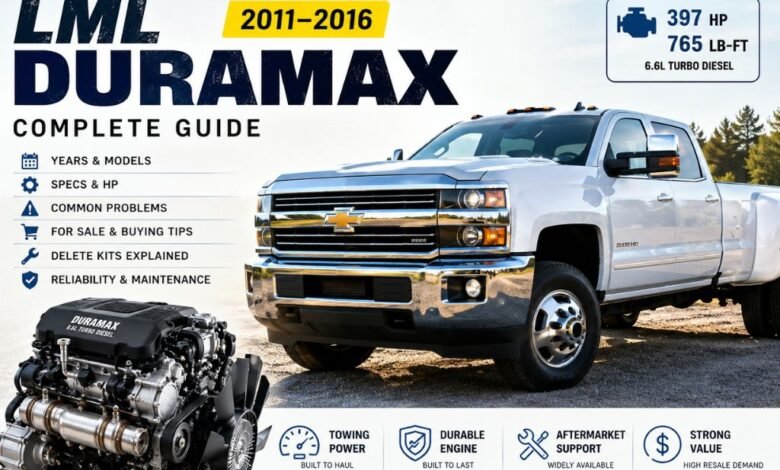
From the factory, the LML Duramax produces an impressive 397 horsepower at 3,000 RPM and 765 lb-ft of torque at just 1,600 RPM. This substantial torque output allows the truck to move heavy loads effortlessly while maintaining strong acceleration and highway passing performance.
Compared with the previous LMM Duramax, which produced 365 horsepower and 660 lb-ft of torque, the LML delivered noticeable improvements in nearly every driving situation. Drivers experienced quicker throttle response, stronger hill-climbing ability, and improved confidence while towing.
The Garrett variable geometry turbocharger plays an important role in delivering smooth power throughout the RPM range. Rather than producing a sudden burst of boost, the turbo adjusts its vane position to optimize airflow, providing consistent acceleration whether the truck is empty or fully loaded.
The Allison transmission complements the engine exceptionally well by keeping shifts smooth and maintaining engine speed within its optimal torque range. This pairing contributes significantly to the LML’s reputation as an excellent towing platform.
Towing Capability and Everyday Driving
Heavy-duty diesel trucks are designed with towing in mind, and the LML Duramax excels in this area. Whether hauling construction equipment, fifth-wheel campers, livestock trailers, or recreational boats, the engine delivers steady pulling power with minimal strain.
The abundant low-end torque allows drivers to accelerate confidently without excessive downshifting. On steep grades, the engine maintains speed effectively while the transmission selects appropriate gears automatically. This creates a relaxed driving experience even under demanding conditions.
For daily commuting, the LML also performs surprisingly well. Highway cruising is quiet, fuel economy is respectable for a truck of its size, and long-distance travel is comfortable thanks to the engine’s smooth operation. Many owners report driving hundreds of thousands of miles with routine maintenance, demonstrating the durability of the engine’s core components.
Reliability of the LML Duramax
When discussing diesel engines, reliability is often the deciding factor for potential buyers. The LML Duramax presents an interesting balance of exceptional durability and a few well-known weaknesses.
The engine block, crankshaft, connecting rods, cylinder heads, and Allison transmission are generally regarded as robust and capable of handling high mileage when serviced properly. Many trucks equipped with the LML engine continue operating beyond 250,000 or even 300,000 miles with regular maintenance.
Routine oil changes, high-quality fuel filters, cooling system service, and proper transmission maintenance play an important role in extending engine life. Owners who follow recommended service intervals often experience years of dependable performance.
However, the LML is not without its challenges. The Bosch CP4 high-pressure fuel pump has become the engine’s most discussed reliability concern. In addition, emissions-related components such as the DEF system, DPF, EGR, and NOx sensors can require repairs as mileage increases. These issues have shaped the engine’s reputation and are important considerations for anyone shopping for a used truck.
Despite these concerns, many diesel enthusiasts still consider the LML Duramax a worthwhile investment because its major mechanical components remain exceptionally durable. With proper maintenance and attention to known problem areas, the engine can provide years of reliable service for towing, work, and everyday driving.
Why the LML Duramax Remains Popular
Even after production ended in 2016, demand for LML-powered trucks remains strong. Buyers appreciate the engine’s balance of modern comfort, impressive factory power, dependable towing performance, and extensive aftermarket support. Replacement parts are widely available, experienced diesel technicians are familiar with the platform, and countless maintenance guides exist for owners who prefer performing routine service themselves.
The LML also represents a transitional generation in diesel truck history. It offers more refinement and technology than older Duramax engines while retaining the rugged characteristics that diesel enthusiasts value. For many buyers, it strikes an appealing balance between traditional heavy-duty capability and modern driving comfort.
As a result, the LML Duramax continues to command solid resale values and remains one of the most sought-after diesel engines in the used heavy-duty truck market.
In the next section, we’ll explore the most common LML Duramax problems, discuss LML Duramax years to avoid, examine what makes the LML Duramax 2016 model unique, explain what buyers should know when searching for an LML Duramax for sale, and cover the topic of LML Duramax delete kits, maintenance recommendations, frequently asked questions, and a final verdict on whether this diesel engine is still worth buying today.
Common LML Duramax Problems
Despite its reputation as a capable and dependable diesel engine, the LML Duramax has several well-documented issues that every prospective buyer should understand. Most of these problems are related to the fuel system and emissions components rather than the engine’s internal design. Knowing these concerns ahead of time allows owners to perform preventive maintenance and avoid expensive repairs.
The most widely discussed issue is the Bosch CP4.2 high-pressure fuel pump. Unlike the CP3 pump used in earlier Duramax engines, the CP4 is more sensitive to poor fuel quality and inadequate lubrication. If the pump fails, it can release metal shavings throughout the entire fuel system. This contamination often reaches the injectors, fuel rails, lines, and fuel tank, turning what begins as a single component failure into a repair costing several thousand dollars. Warning signs may include hard starting, rough idling, loss of power, reduced fuel pressure, or a complete no-start condition.
The emissions system is another area where owners occasionally encounter problems. The Diesel Exhaust Fluid (DEF) system, Selective Catalytic Reduction (SCR), Diesel Particulate Filter (DPF), and NOx sensors all play important roles in reducing emissions, but these components become more prone to faults as mileage increases. Failed sensors, clogged filters, or malfunctioning DEF heaters can trigger warning lights and even force the truck into reduced-power mode until repairs are completed.
EGR valve carbon buildup is another issue that may appear over time. Excessive soot accumulation can restrict airflow, resulting in rough idle, sluggish acceleration, increased smoke, and lower fuel efficiency. Regular highway driving and proper maintenance help reduce the likelihood of excessive carbon deposits.
Some owners also experience injector wear after very high mileage. Symptoms include rough engine operation, poor fuel economy, excessive smoke, and reduced engine performance. Fortunately, injector problems are generally less common than CP4-related failures.
Overall, while these issues deserve attention, many LML Duramax trucks continue operating reliably for hundreds of thousands of miles when properly maintained.
LML Duramax Years to Avoid
One of the most searched questions is about LML Duramax years to avoid. Since every LML engine uses the same Bosch CP4 high-pressure fuel pump, no production year is completely free from its associated risks.
Many diesel enthusiasts recommend exercising additional caution when purchasing 2011 through 2014 models because these trucks represent the earliest years of the LML platform and are more likely to have accumulated higher mileage. Earlier trucks may also have older emissions components that require replacement simply because of age and use.
The 2015 and 2016 models are generally considered the most desirable within the LML generation. By these years, General Motors had refined software calibrations and addressed minor production improvements. However, buyers should understand that the CP4 fuel pump remained unchanged, meaning later models can still experience the same fuel system issue if preventive measures have not been taken.
Rather than avoiding a specific year entirely, many experienced buyers focus on maintenance history. A well-maintained 2012 truck with documented service records may prove to be a better purchase than a neglected 2016 model.
Why the LML Duramax 2016 Is So Popular
The LML Duramax 2016 holds a special place among diesel truck enthusiasts because it represents the final year before the introduction of the L5P Duramax.
Many buyers appreciate the 2016 model because it combines updated styling, a refined interior, modern technology, and the final evolution of the LML platform. These trucks typically feature the same factory output of 397 horsepower and 765 lb-ft of torque while benefiting from years of incremental improvements throughout the production cycle.
Another advantage of the 2016 model is resale value. Since it is the newest truck equipped with the LML engine, demand remains strong in the used market. Buyers who prefer the familiar Allison six-speed transmission and proven LML platform often seek out clean, low-mileage 2016 examples.
Although it still shares the CP4 fuel pump and emissions equipment found in earlier years, many owners consider the 2016 model to be the best balance of performance, comfort, and long-term ownership potential.
Finding an LML Duramax for Sale
If you are searching for an LML Duramax for sale, patience and careful inspection can save thousands of dollars in future repair costs.
Before purchasing any used diesel truck, request complete maintenance records whenever possible. Consistent oil changes, regular fuel filter replacements, transmission service, and documented cooling system maintenance indicate responsible ownership.
Inspect the truck for warning lights, unusual engine noises, excessive exhaust smoke, or signs of poor repairs. A professional pre-purchase inspection by a diesel technician is highly recommended, especially for higher-mileage vehicles.
Pay close attention to fuel system health. If the truck has already received a preventive CP4 replacement or upgrade, that may add value and reduce future risk. Likewise, verify that the emissions system is functioning correctly without active diagnostic trouble codes.
Mileage alone should not determine whether a truck is worth buying. A properly maintained LML Duramax with 180,000 miles can often be a better investment than a neglected truck with significantly fewer miles.
LML Duramax Delete Kit
Another frequently searched topic is the LML Duramax delete kit. Many owners research modifications involving the removal of emissions components such as the DPF, EGR, or DEF system in an effort to simplify the engine and reduce maintenance.
It is important to understand that removing or disabling factory-installed emissions equipment is illegal for on-road vehicles in many countries and regions, including under United States federal law. Such modifications may also void warranties, prevent a vehicle from passing emissions inspections, and expose owners to legal penalties depending on local regulations.
For this reason, buyers should carefully review the laws that apply in their location before considering any emissions-related modifications. Maintaining the factory emissions system and following recommended service intervals is the safest and most compliant approach for vehicles driven on public roads.
Maintenance Tips for Long Engine Life
Routine maintenance is the key to maximizing the lifespan of an LML Duramax. High-quality diesel fuel, timely fuel filter replacement, regular oil changes using manufacturer-approved lubricants, and scheduled transmission service all contribute to long-term reliability.
Many experienced owners also recommend purchasing fuel from reputable stations to reduce contamination risks and keeping the DEF system properly maintained. Allowing the engine to complete DPF regeneration cycles during highway driving can also help prevent excessive soot buildup.
Monitoring warning lights and addressing minor issues early often prevents significantly more expensive repairs later. Preventive maintenance generally costs far less than replacing major fuel system or emissions components after a failure occurs.
Is the LML Duramax Still Worth Buying?
Even years after production ended, the LML Duramax continues to be one of the most capable diesel engines available in the used heavy-duty truck market. Its combination of nearly 400 horsepower, outstanding towing capacity, comfortable highway performance, and durable Allison transmission makes it an attractive choice for both work and recreation.
While buyers should understand the potential risks associated with the CP4 fuel pump and emissions system, these concerns do not automatically make the engine unreliable. Thousands of LML-powered trucks continue to provide dependable service every day, particularly when they have been maintained properly throughout their lives.
For buyers who need serious towing capability without purchasing a brand-new diesel truck, a well-maintained LML Duramax remains an excellent option. Taking time to inspect service history, verify fuel system condition, and evaluate overall maintenance can make the difference between purchasing a dependable workhorse and inheriting expensive repairs.
Frequently Asked Questions
What years are the LML Duramax?
The LML Duramax was produced from 2011 through 2016 for Chevrolet Silverado HD and GMC Sierra HD trucks.
How much horsepower does the LML Duramax make?
The factory rating is 397 horsepower and 765 lb-ft of torque, making it significantly more powerful than the previous LMM generation.
Which LML Duramax year is the best?
Many buyers prefer the 2015 and 2016 models because they represent the newest versions of the LML platform while retaining the same proven powertrain.
What is the biggest problem with the LML Duramax?
The Bosch CP4.2 high-pressure fuel pump is widely regarded as the engine’s most significant reliability concern because its failure can contaminate the entire fuel system.
Is the LML Duramax good for towing?
Yes. The engine delivers excellent low-end torque, strong highway performance, and impressive towing capability, making it ideal for heavy trailers, RVs, commercial equipment, and recreational hauling.
Conclusion
The LML Duramax remains one of General Motors’ most influential diesel engines, offering an outstanding blend of power, refinement, and heavy-duty capability. Produced from 2011 to 2016, it raised the bar with 397 horsepower, 765 lb-ft of torque, advanced turbocharging, and excellent towing performance that continues to impress truck owners today. Although the engine is known for concerns such as the CP4 fuel pump and emissions-related components, its robust internal construction and dependable Allison transmission have helped countless trucks achieve exceptionally high mileage.
Whether you’re researching LML Duramax years, comparing LML Duramax specs, evaluating LML Duramax problems, searching for an LML Duramax for sale, or considering the highly desirable 2016 LML Duramax, the key is to prioritize maintenance history over model year alone. A carefully maintained truck can provide years of reliable service, making the LML Duramax a strong contender for anyone seeking a capable, powerful, and proven heavy-duty diesel pickup.