Jadeitový kameň: The Complete Guide to One of the World’s Most Precious Gemstones

Introduction
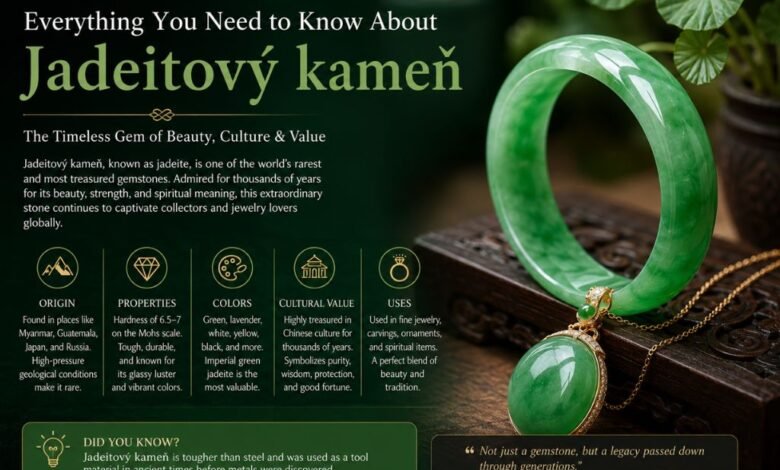
The term “Jadeitový kameň” refers to jadeite, one of the rarest and most valuable gemstones on Earth. Revered for centuries across cultures—especially in Asia—jadeite has long been associated with beauty, purity, and power. While many people casually use the word “jade” to describe green ornamental stones, true jade consists of only two minerals: jadeite and nephrite. Among these, jadeite stands out as the more valuable and sought-after variety.
This article explores everything you need to know about Jadeitový kameň, from its geological origins and physical properties to its cultural importance, uses, and market value.
What is Jadeitový kameň?
Jadeitový kameň (jadeite) is a silicate mineral composed primarily of sodium and aluminum. It belongs to the pyroxene group of minerals and forms under high-pressure, low-temperature conditions deep within the Earth’s crust. Unlike many gemstones that occur as large crystals, jadeite typically appears as dense, interlocking granular masses.
What makes jadeite particularly special is not just its rarity, but its exceptional toughness. While it is not the hardest gemstone, it is one of the toughest, meaning it resists breaking and fracturing better than many other minerals.
Physical and Chemical Properties
Understanding the properties of Jadeitový kameň helps explain why it has been so highly valued throughout history.
Basic Characteristics:
- Chemical Formula: NaAlSi₂O₆
- Mineral Group: Pyroxene
- Hardness: 6.5–7 on the Mohs scale
- Density: 3.3–3.5 g/cm³
- Luster: Vitreous (glassy)
- Transparency: Opaque to semi-transparent
Toughness and Structure
Jadeite’s interlocking crystal structure gives it remarkable durability. This makes it ideal for carving and shaping into intricate designs, which is one reason it has been used for tools and ornaments for thousands of years.
Colors of Jadeitový kameň
One of the most captivating aspects of jadeite is its wide range of colors. While green is the most famous, jadeite actually appears in several hues.
Common Colors:
- Emerald Green: Known as Imperial Jade, the most valuable type
- White: Often called “mutton fat jade”
- Lavender: Highly prized in modern jewelry
- Yellow and Orange: Caused by iron oxidation
- Black: Dense and opaque
- Blue: Rare and subtle
The color of Jadeitový kameň is influenced by trace elements such as chromium (green), iron (yellow/brown), and manganese (lavender).
Where is Jadeitový kameň Found?
Jadeite forms under very specific geological conditions, making it relatively rare. It is typically found in subduction zones where tectonic plates collide.
Major Sources:
- Myanmar (Burma): The world’s primary and most famous source
- Guatemala: Known for vibrant and unique colors
- Japan: Historically significant deposits
- Russia: Smaller occurrences
- United States (California): Limited deposits
Among these, Myanmar produces the highest quality jadeite, especially the highly prized Imperial Jade.
Jadeitový kameň vs. Nephrite
Although both jadeite and nephrite are called “jade,” they differ significantly in composition and value.
Key Differences:
| Feature | Jadeitový kameň (Jadeite) | Nephrite |
|---|---|---|
| Composition | Sodium-aluminum silicate | Calcium-magnesium silicate |
| Rarity | Rare | More common |
| Value | Higher | Lower |
| Colors | More vibrant | More subdued |
| Luster | Glassy | Waxy |
Because of its rarity and vivid colors, Jadeitový kameň is generally considered superior in the gemstone market.
Historical and Cultural Significance
Ancient Civilizations
Jadeite has been used for thousands of years in different parts of the world. In Central America, ancient civilizations such as the Maya and Olmec carved jadeite into ceremonial objects, masks, and tools.
Chinese Culture
No discussion of Jadeitový kameň is complete without mentioning its importance in Chinese culture. For over 3,000 years, jade has symbolized:
- Purity
- Wisdom
- Harmony
- Immortality
In ancient China, jade was often more valuable than gold. It was used in:
- Imperial jewelry
- Ritual objects
- Burial suits for royalty
Today, jadeite continues to hold deep cultural and spiritual significance in many Asian societies.
Uses of Jadeitový kameň
Jewelry
Jadeite is widely used in fine jewelry due to its beauty and durability. Popular items include:
- Bracelets
- Rings
- Necklaces
- Earrings
- Pendants
High-quality jadeite jewelry is often passed down through generations as heirlooms.
Decorative and Artistic Objects
Because of its toughness, jadeite is ideal for carving. It is commonly used to create:
- Sculptures
- Figurines
- Decorative ornaments
Spiritual and Healing Uses
In many cultures, Jadeitový kameň is believed to have metaphysical properties, such as:
- Promoting balance and harmony
- Attracting good luck and prosperity
- Providing protection from negative energy
While these beliefs are not scientifically proven, they contribute to jadeite’s enduring popularity.
Quality and Value Factors
The value of jadeite depends on several key factors:
1. Color
The most important factor. Rich, vivid green (Imperial Jade) is the most valuable.
2. Transparency
Semi-transparent jadeite is more valuable than opaque varieties.
3. Texture
Fine, smooth texture indicates higher quality.
4. Cut and Craftsmanship
Well-carved and polished pieces command higher prices.
5. Treatment
Untreated (natural) jadeite is significantly more valuable than treated stones.
Types of Jadeite Treatment
Not all jadeite on the market is natural. Treatments are often used to enhance its appearance.
Common Types:
- Type A: Natural and untreated (most valuable)
- Type B: Chemically treated and polymer-injected
- Type C: Dyed to improve color
When purchasing Jadeitový kameň, it is essential to verify whether the stone has been treated.
How to Identify Genuine Jadeitový kameň
With many imitations available, identifying real jadeite can be challenging.
Tips:
- Check the weight: Jadeite feels heavier than most imitations
- Examine texture: Genuine jadeite has a smooth, dense structure
- Look at color distribution: Natural jadeite often has uneven coloring
- Request certification: Always buy from reputable sellers
Professional gemological testing is the most reliable way to confirm authenticity.
Caring for Jadeitový kameň
Proper care ensures that jadeite retains its beauty for generations.
Care Tips:
- Clean with warm water and mild soap
- Avoid harsh chemicals and ultrasonic cleaners
- Store separately to prevent scratches
- Handle with care despite its toughness
Jadeite is durable, but it should still be treated with respect.
Modern Popularity
In recent years, Jadeitový kameň has seen a resurgence in global popularity. Luxury collectors and jewelry enthusiasts value it not only for its beauty but also as an investment.
High-quality jadeite pieces have been sold at auctions for millions of dollars, making it one of the most valuable gemstones in the world.
Interesting Facts About Jadeitový kameň
- The name “jade” comes from the Spanish phrase piedra de ijada, meaning “stone of the flank.”
- Jadeite was used for tools before metals became widely available.
- It is tougher than steel in terms of resistance to breaking.
- Some jadeite artifacts are over 5,000 years old.
Conclusion
Jadeitový kameň is far more than just a beautiful gemstone. It is a symbol of history, culture, and natural wonder. From ancient civilizations to modern luxury markets, jadeite has maintained its status as one of the most treasured materials on Earth.
Its rarity, durability, and stunning range of colors make it a unique gemstone that continues to captivate collectors and enthusiasts worldwide. Whether appreciated for its aesthetic appeal, cultural significance, or potential investment value, jadeite remains truly timeless.