
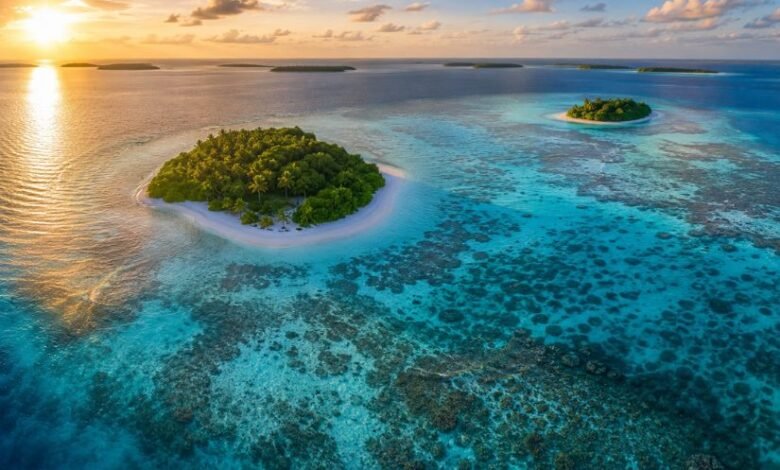
Some places on Earth feel less like geography and more like a secret the ocean has been keeping for centuries. Far from shipping routes, beyond crowded coastlines, and deep inside the Banda Sea lies one of those rare mysteries—Lucipara. It is not a city, not a tourist destination, and not even a place most maps highlight with confidence. Yet it exists quietly as a cluster of remote coral islands that continue to intrigue geographers, marine scientists, and explorers.
The name Lucipara carries a sense of isolation wrapped in ocean winds and coral silence. For some, it represents untouched marine ecosystems. For others, it is a historical navigation point forgotten by modern travel. But for anyone studying Earth’s last wild marine frontiers, Lucipara is far more than a name—it is a living laboratory of ocean life.
The Silent Geography of Lucipara Islands
The Lucipara Islands are a small, remote group of coral islands located in the Banda Sea within Indonesia’s Maluku Province. They sit far from major settlements, surrounded by deep ocean waters and powerful marine currents that have shaped both their isolation and their ecological richness.
Unlike well-known island chains such as Bali or the Philippines’ Palawan region, Lucipara does not host tourism infrastructure or permanent human settlements. Instead, it remains a natural formation shaped almost entirely by coral growth and oceanic forces.
These islands are often described as:
- Extremely remote
- Sparsely mapped in detail
- Surrounded by deep ocean trenches
- Formed primarily from coral atolls
This isolation is not accidental—it is the reason Lucipara has remained biologically intact.
A Place Where Humans Never Stayed
One of the most striking facts about Lucipara is the absence of permanent human life. There are no villages, no roads, and no urban footprint. Occasional fishing activity from nearby Indonesian communities may bring people close to its waters, but no civilization has ever established itself here.
This absence has created a rare condition in modern geography: an ecosystem that evolved without direct human pressure.
Imagine stepping onto an island where:
- The only sound is wind and waves
- Coral reefs remain unbroken by construction
- Marine life behaves as it did centuries ago
Lucipara represents exactly that kind of untouched environment.
The Coral Kingdom Beneath the Surface
If the islands themselves are quiet, the waters around them are anything but empty. Lucipara sits within one of the most biologically rich marine zones on the planet—the Coral Triangle.
This region is often called the “Amazon of the Ocean” due to its extraordinary biodiversity. Around Lucipara, marine scientists have identified:
- Dense coral reef systems
- Reef fish populations in high diversity
- Migratory species such as tuna and sharks
- Likely presence of undocumented marine organisms
The coral structures here act as underwater cities. Each branch and formation provides shelter, breeding grounds, and feeding zones for thousands of marine species.
Because the environment is so isolated, it is believed that Lucipara’s reefs may serve as a reference point for understanding what coral ecosystems looked like before large-scale human impact.
Why Scientists Pay Attention to Lucipara
Lucipara may be remote, but it is not ignored by science. In fact, its isolation makes it highly valuable for research.
Marine biologists and environmental scientists study regions like Lucipara to understand:
- Natural coral reef resilience
- Effects of climate change in untouched ecosystems
- Baseline biodiversity levels without pollution
- Ocean current influence on reef development
Because human interference is minimal, data from Lucipara can help scientists compare disturbed reefs with natural ones. This makes it a “control zone” in global marine research.
In environmental terms, Lucipara is not just an island group—it is a benchmark.
Historical Echoes in Navigation
Long before modern GPS systems, sailors depended on scattered island groups across the Indonesian archipelago to navigate the vast seas. Lucipara occasionally appeared in old maritime records and navigation charts, where it served more as a directional reference than a destination.
Historical explorers passing through the Banda Sea documented such islands as part of their long ocean voyages. While Lucipara never became a colonial settlement or trading hub, its presence helped shape early sea navigation routes across Southeast Asia.
Over time, as mapping technology improved and shipping routes modernized, Lucipara faded from mainstream awareness.
The Mystery of Its Name
The origin of the name “Lucipara” is not entirely clear, but linguistic and historical interpretations suggest it may derive from older maritime naming traditions used during early European exploration of the Indonesian seas.
Unlike many place names tied to local languages, Lucipara appears in historical records more as a mapped label than a cultural designation. This adds another layer of mystery—its identity is defined more by cartography than by human settlement.
Nature Without Interruption
One of the most fascinating aspects of Lucipara is what it lacks:
- No urban development
- No tourism industry
- No industrial fishing zones
- No infrastructure footprint
This absence is increasingly rare in today’s world. As coastal regions become heavily populated and marine ecosystems face pressure from overfishing and warming oceans, places like Lucipara become ecological sanctuaries by default.
The reefs here continue to grow, adapt, and evolve without interruption. Fish populations follow natural cycles. Coral structures develop according to environmental conditions rather than human interference.
Climate and Environmental Sensitivity
While Lucipara is remote, it is not immune to global environmental changes. Coral reefs worldwide are under stress from rising sea temperatures and ocean acidification, and Lucipara is no exception.
However, its isolation may give it a slight advantage:
- Less direct pollution exposure
- Reduced coastal development impact
- Lower human-induced sedimentation
Even so, climate-driven changes remain a serious concern. Scientists view Lucipara as an early indicator zone for how remote reefs respond to global warming.
Cultural Silence, Scientific Voice
Unlike many island regions in Indonesia with rich cultural traditions and inhabited histories, Lucipara stands apart due to its lack of human cultural layering.
There are:
- No indigenous settlements
- No traditional architecture
- No cultural festivals tied to the islands
Instead, Lucipara’s “story” is told through science, maps, and ocean currents rather than folklore or community history.
This makes it one of the rare places where nature is the only storyteller.
Why Lucipara Matters Today
In a world where untouched environments are disappearing rapidly, Lucipara holds symbolic and scientific importance.
It represents:
- What marine ecosystems look like without heavy human influence
- A baseline for ecological restoration projects
- A natural archive of coral reef evolution
- A reminder of oceanic biodiversity still hidden from mass awareness
It is not a destination for tourism development, but rather a place for observation, protection, and understanding.
The Quiet Future of Lucipara
Looking ahead, the future of Lucipara depends on global environmental responsibility. If protected, it may continue to serve as a living laboratory for marine science. If neglected, it could face the same ecological pressures affecting reefs across the Indo-Pacific.
The challenge is not to transform Lucipara—but to preserve its untouched condition.
Because places like this are not just islands. They are memory banks of Earth’s natural history.
Final Reflection
Lucipara does not demand attention. It does not advertise itself with beaches or resorts. Instead, it exists quietly in the Banda Sea, shaped by coral, current, and time.
And perhaps that is what makes it remarkable.
It is a reminder that even in a mapped and measured world, there are still corners of the ocean that remain beautifully unresolved.
