Visual Effects Techniques: The Complete Guide to VFX in Film, Movies, CGI, and Modern Filmmaking

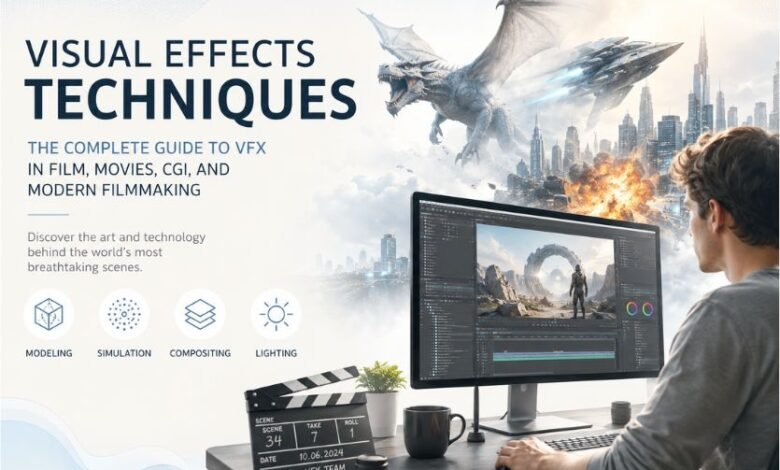
The breathtaking worlds seen in today’s biggest movies rarely exist in real life. Towering futuristic cities, mythical creatures, realistic explosions, distant galaxies, and dramatic natural disasters are often the result of carefully crafted visual effects. Modern filmmaking has evolved beyond the limits of physical sets and practical effects, allowing creators to bring almost any imagination to life on screen. Whether it is a superhero soaring through the sky or an ancient civilization recreated from history, visual effects have become one of the most powerful storytelling tools in the entertainment industry.
From blockbuster films to television series, advertisements, video games, and streaming content, visual effects continue to reshape how audiences experience visual storytelling. As technology advances, filmmakers are discovering new ways to blend live-action footage with digital artistry, making scenes more immersive and believable than ever before. Understanding visual effects techniques not only helps movie enthusiasts appreciate the craftsmanship behind their favorite productions but also provides valuable knowledge for aspiring filmmakers, designers, and digital artists.
What Is Visual Effects?
Visual effects, commonly abbreviated as VFX, refer to the process of creating or enhancing imagery that cannot be captured during live-action filming. These effects are produced during post-production using specialized computer software and advanced digital techniques. The goal of visual effects is to seamlessly combine real footage with computer-generated elements so that the final scene appears realistic and convincing.
Unlike traditional practical effects, which rely on physical props, makeup, miniature models, or pyrotechnics during filming, visual effects are created digitally after the cameras stop rolling. This flexibility allows filmmakers to modify scenes, create impossible environments, add digital characters, remove unwanted objects, or completely transform a filmed location into something entirely different.
Today, visual effects are not limited to science fiction or fantasy films. They are frequently used in romantic dramas, historical documentaries, action films, television commercials, educational videos, and even social media content. Many viewers never realize that hundreds of visual effects shots may exist within a single movie because the best VFX remain virtually invisible.
The Evolution of Visual Effects
Visual effects have come a long way since the early days of cinema. In the early twentieth century, filmmakers relied on camera tricks, double exposure photography, painted backdrops, and miniature models to create visual illusions. These methods laid the foundation for modern filmmaking by proving that audiences could be transported into imaginary worlds through creative visual storytelling.
As technology progressed, optical compositing became widely used, allowing multiple film elements to be combined into a single frame. This innovation opened new creative possibilities for directors and visual artists.
The arrival of computers during the late twentieth century revolutionized the film industry. Computer-generated imagery, commonly known as CGI, transformed how movies were produced. Films such as Jurassic Park demonstrated that digital creatures could appear remarkably lifelike, while later productions expanded these possibilities even further with fully digital environments and realistic simulations.
Today, advancements in artificial intelligence, real-time rendering, virtual production, and cloud computing continue to push visual effects into new territory. Modern VFX studios can create entire worlds that are almost impossible to distinguish from real-life photography.
Why Visual Effects Are Important in Modern Filmmaking
Visual effects have become an essential part of filmmaking because they remove creative limitations. Directors are no longer restricted by physical locations, weather conditions, safety concerns, or budget constraints. Instead, they can visualize stories that would otherwise be impossible to produce.
One of the biggest advantages of visual effects is creative freedom. Fantasy kingdoms, alien planets, prehistoric landscapes, and futuristic cities can all be built digitally with incredible detail. This allows storytellers to present ideas that capture the imagination of audiences around the world.
Visual effects also improve production safety. Dangerous explosions, collapsing buildings, high-speed vehicle crashes, and risky stunts can be simulated digitally rather than performed in real life. This reduces the risk of injury while still delivering spectacular action sequences.
Another significant benefit is cost efficiency. Although advanced visual effects require skilled artists and powerful software, creating digital environments can often be less expensive than building enormous physical sets or traveling to multiple filming locations.
VFX also enhances realism. Even films that appear entirely realistic often contain digital sky replacements, invisible object removal, crowd extensions, lighting corrections, and environmental enhancements that viewers never notice. These subtle improvements contribute significantly to the overall quality of a production.
Visual Effects Techniques in Film
Visual effects techniques in film are carefully integrated throughout every stage of production. Rather than being added only at the end, VFX planning begins during the earliest phases of filmmaking.
During pre-production, directors, producers, cinematographers, and VFX supervisors collaborate to determine which scenes will require digital enhancements. Storyboards, concept artwork, and previsualization animations help the production team understand how visual effects will fit into the overall story. This planning stage ensures that cameras, lighting, and actor performances are designed to accommodate the digital elements that will later be added.
During production, actors often perform in front of green or blue screens while wearing motion tracking markers. Special cameras record movement and lighting information so that digital artists can accurately integrate computer-generated objects into the live-action footage. VFX supervisors remain on set to ensure that every shot captures the necessary data for post-production.
The majority of visual effects work occurs during post-production. Artists create digital models, animate characters, simulate weather effects, build realistic environments, adjust lighting, and combine multiple visual layers into seamless final shots. Advanced rendering software calculates how light interacts with digital objects, helping them blend naturally with real-world footage.
This collaborative process involves dozens or even hundreds of specialized artists working together across multiple departments. Each stage contributes to creating believable visuals that support the director’s creative vision.
Visual Effects vs Special Effects
Although many people use the terms interchangeably, visual effects and special effects are different concepts.
Special effects, often abbreviated as SFX, are created physically during filming. These include practical explosions, prosthetic makeup, mechanical creatures, smoke machines, miniature models, rain effects, animatronics, and controlled pyrotechnics. Because these effects happen on set, actors can interact with them directly during filming.
Visual effects, on the other hand, are created digitally after filming has been completed. They involve computer-generated imagery, compositing, digital environments, motion capture animation, object removal, and countless other post-production techniques.
Modern productions frequently combine both methods to achieve the most realistic results. A practical explosion may be enhanced with digital fire, smoke, debris, and environmental destruction, creating a scene that appears far larger and more dramatic than what was physically filmed. This combination allows filmmakers to preserve realism while expanding creative possibilities far beyond the limits of traditional filmmaking.
Most Popular Visual Effects Techniques
The remarkable visuals seen in modern cinema are the result of numerous specialized techniques working together. Each method serves a unique purpose, allowing artists to create believable digital environments, realistic characters, and breathtaking action sequences. Understanding these visual effects techniques helps explain how filmmakers transform ordinary footage into extraordinary cinematic experiences.
Computer-Generated Imagery (CGI)
Computer-Generated Imagery, commonly referred to as CGI, is the foundation of modern visual effects. It involves creating digital objects, characters, environments, vehicles, and entire worlds using advanced 3D software. CGI enables filmmakers to produce scenes that would be impossible, dangerous, or extremely expensive to film in real life.
Artists begin by modeling three-dimensional objects before applying textures, lighting, and animations that make them appear realistic. Sophisticated rendering engines simulate how light interacts with digital surfaces, ensuring that CGI blends naturally with live-action footage. Modern CGI has reached a level where audiences often cannot distinguish between real and computer-generated imagery.
Many of today’s biggest blockbuster films depend heavily on CGI to create superheroes, fantasy creatures, space battles, underwater kingdoms, and futuristic cities. Even realistic dramas often use CGI to remove modern buildings, extend landscapes, or recreate historical settings without viewers ever noticing.
Green Screen and Chroma Key Technology
Green screen technology is one of the most recognizable visual effects techniques in movies. Actors perform in front of a brightly colored green or blue background, which is later replaced with digital scenery during post-production through a process known as chroma keying.
This technique allows filmmakers to place actors in locations that would otherwise be inaccessible, such as outer space, magical kingdoms, underwater environments, or historical cities. It also enables productions to avoid expensive travel by digitally recreating distant locations.
Successful green screen work depends heavily on consistent lighting, accurate camera tracking, and careful color separation. When executed correctly, audiences rarely realize that the actors were never physically present in the final environment.
Compositing
Compositing is the process of combining multiple visual elements into a single seamless image. Live-action footage, CGI models, explosions, smoke, weather effects, digital backgrounds, and lighting adjustments are merged together until they appear as one continuous scene.
Professional compositors carefully adjust colors, shadows, reflections, depth of field, and motion blur to ensure every layer blends naturally. Even a simple shot may contain dozens of separate visual layers that become invisible after compositing.
Without compositing, modern visual effects would appear disconnected and unrealistic. It serves as the final stage where all digital elements come together into a polished cinematic image.
Motion Capture
Motion capture, often called MoCap, records an actor’s body movements using specialized cameras and tracking markers. These movements are then transferred to digital characters, allowing them to move naturally while preserving the original actor’s performance.
This technology has transformed character animation by producing lifelike facial expressions, realistic body language, and emotional performances that traditional animation alone cannot easily achieve.
Motion capture is commonly used for fantasy creatures, superheroes, video game characters, and digital humans. Rather than replacing actors, it allows their performances to live through entirely digital characters while maintaining authentic human emotion.
Rotoscoping
Rotoscoping is one of the oldest yet still highly valuable visual effects techniques. Artists manually trace or isolate people and objects frame by frame, creating precise masks that allow specific parts of an image to be edited independently.
This painstaking process is frequently used for background replacement, object removal, color correction, and integrating computer-generated elements behind or in front of actors. Although modern software includes AI-assisted masking tools, rotoscoping remains an essential skill for complex visual effects work where automatic tracking is insufficient.
Match Moving and Camera Tracking
When digital objects must remain perfectly aligned with live-action footage, artists rely on match moving or camera tracking. Specialized software analyzes the movement of the original camera and recreates that exact movement within a virtual three-dimensional environment.
Once the camera movement has been reconstructed, digital objects can be placed naturally into the scene. Whether adding a flying spaceship, towering building, or animated creature, the CGI will move realistically with the original camera, maintaining proper perspective and depth throughout the shot.
This technique has become essential for integrating digital environments into handheld, drone, and moving camera footage.
Matte Painting
Matte painting is the art of creating large-scale digital environments that extend beyond what was physically filmed. Instead of constructing enormous sets, artists design breathtaking landscapes, castles, futuristic skylines, mountains, forests, and alien planets using high-resolution digital artwork.
Modern matte paintings often combine photographs, digital painting, and three-dimensional elements to achieve extraordinary realism. These backgrounds are then blended with live-action footage using compositing techniques.
Many scenes that appear to have been filmed in exotic or impossible locations are actually created through detailed matte paintings combined with minimal practical sets.
Particle Simulation
Natural elements such as fire, smoke, sparks, dust, rain, snow, explosions, and debris are usually generated using particle simulation systems. Instead of animating every individual particle manually, artists define physical rules that control how thousands or even millions of particles behave.
These simulations accurately reproduce gravity, wind, turbulence, collisions, and lighting interactions, resulting in highly realistic environmental effects. Particle systems allow filmmakers to create dramatic battle scenes, volcanic eruptions, collapsing buildings, and severe weather conditions while maintaining complete creative control.
Fluid Simulation
Creating believable liquids represents one of the greatest challenges in computer graphics. Fluid simulation software mathematically recreates the behavior of water, oceans, rivers, waves, lava, mud, and other liquids by calculating pressure, velocity, and movement across every frame.
Fluid simulations are commonly used in disaster films, underwater adventures, fantasy movies, and action sequences involving floods or storms. Combined with realistic lighting and compositing, these simulations often become indistinguishable from real water.
Cloth and Hair Simulation
Digital clothing and hair must respond naturally to movement, gravity, and environmental forces. Cloth simulation calculates how fabrics fold, wrinkle, stretch, and react to wind, while hair simulation recreates the complex movement of individual strands.
These techniques are especially important for animated characters, superheroes with flowing capes, fantasy costumes, and realistic digital humans. Without accurate cloth and hair simulation, even the most advanced CGI characters would appear artificial.
Crowd Simulation
Large battlefields, sports stadiums, city streets, and historical gatherings often require thousands of people. Instead of hiring massive numbers of extras, filmmakers use crowd simulation software to generate digital populations that move independently.
Each virtual character can be assigned different behaviors, walking patterns, reactions, and animations, creating scenes that appear naturally populated. Crowd simulation significantly reduces production costs while allowing directors to stage events on an enormous scale.
Digital De-Aging and Face Replacement
Advancements in artificial intelligence and facial tracking have introduced highly realistic digital de-aging and face replacement techniques. Artists can make actors appear decades younger or older while preserving their recognizable facial expressions.
Face replacement is also widely used for stunt doubles, allowing dangerous action sequences to be performed safely while maintaining the appearance of the original actor. These technologies continue to improve rapidly, becoming increasingly common in major film productions.
Visual Effects Techniques in Movies
Visual effects techniques in movies extend far beyond spectacular explosions and fantasy creatures. Many productions rely on invisible visual effects that audiences never consciously notice. Digital artists routinely remove microphones, safety equipment, unwanted buildings, reflections, camera rigs, and production crews from scenes. They replace cloudy skies, extend city skylines, add realistic crowds, improve lighting, enhance landscapes, and seamlessly combine multiple takes into a single shot.
Because these enhancements are designed to remain unnoticed, viewers often assume they are looking at untouched live-action footage. In reality, modern films may contain hundreds or even thousands of visual effects shots, many of which simply improve realism rather than create obvious fantasy elements.
Visual Effects Techniques Examples
The evolution of visual effects has given filmmakers the ability to create scenes that were once considered impossible. Some of the world’s most successful movies have become landmarks in cinematic history because of their groundbreaking use of VFX.
One of the earliest examples is Jurassic Park, which introduced remarkably realistic computer-generated dinosaurs that forever changed audience expectations. The combination of CGI and practical animatronics demonstrated how digital technology could enhance storytelling while maintaining realism.
Avatar raised the standard even further by using advanced motion capture, facial performance capture, and fully digital environments to create the alien world of Pandora. Every plant, creature, and landscape was carefully designed to immerse viewers in a believable fictional universe.
Superhero films such as the Marvel Cinematic Universe rely heavily on CGI, compositing, green screen technology, and digital simulations. Characters fly through massive cities, battle alien armies, and perform impossible stunts, all made possible through sophisticated visual effects techniques.
Science fiction productions like Interstellar used highly accurate visual simulations to recreate black holes, distant galaxies, and space travel while collaborating with scientific experts to ensure realism. Similarly, fantasy films have employed digital creatures, magical environments, and large-scale battle sequences that would be impossible to film practically.
Even films that appear grounded in reality frequently depend on visual effects. Historical dramas recreate buildings that no longer exist, action films remove safety equipment and stunt rigs, while romantic movies may digitally improve skies, landscapes, and city backgrounds. These invisible effects demonstrate that VFX is not only about spectacle but also about subtle enhancement.
Popular Software Used for Visual Effects
Professional visual effects studios rely on a wide range of specialized software to create high-quality digital imagery. Each application is designed for specific stages of the production pipeline, allowing artists to collaborate efficiently on complex projects.
Adobe After Effects remains one of the most popular tools for motion graphics, compositing, visual enhancements, and simple animation projects. It is widely used by independent creators, marketing agencies, and television production companies.
Autodesk Maya is considered one of the industry’s leading applications for three-dimensional modeling, animation, character rigging, and rendering. Many Hollywood studios use Maya to produce feature films and animated productions.
Blender has gained enormous popularity because it provides professional-grade modeling, sculpting, animation, simulation, and rendering capabilities without licensing costs. Its growing community continues to contribute new features that make it increasingly competitive with commercial software.
Houdini specializes in procedural animation and advanced simulations. It is particularly respected for creating realistic explosions, fire, smoke, water, destruction, and particle effects that appear in blockbuster movies.
Foundry Nuke is widely regarded as the industry standard for high-end compositing. It enables artists to combine hundreds of visual layers while maintaining exceptional image quality and flexibility.
Cinema 4D is commonly used for motion graphics, broadcast design, and commercial production due to its intuitive workflow and powerful rendering capabilities.
Unreal Engine has transformed modern filmmaking by enabling real-time rendering and virtual production. Instead of waiting hours for rendered images, filmmakers can view highly realistic environments instantly while filming, making production faster and more interactive.
Visual Effects Techniques PDF and PPT Resources
Students, educators, and aspiring VFX artists frequently search for visual effects techniques PDF and visual effects techniques PPT resources to support their learning. These materials typically explain the principles of CGI, compositing, chroma keying, motion capture, rotoscoping, rendering, and post-production workflows.
Educational PDFs often provide detailed explanations of production pipelines, software comparisons, and technical terminology, making them useful for classroom study and self-learning. Presentation slides in PPT format summarize these concepts with diagrams, illustrations, and workflow charts that help simplify complex ideas.
Many universities, film schools, and online learning platforms offer downloadable study materials covering beginner and advanced visual effects techniques. These resources are especially valuable for students preparing presentations, assignments, or professional certifications in animation and digital filmmaking.
The Future of Visual Effects
The future of visual effects is being shaped by rapid technological innovation. Artificial intelligence is automating repetitive tasks such as object removal, background generation, facial tracking, and image enhancement, allowing artists to focus more on creativity.
Virtual production has become one of the industry’s most significant developments. Instead of filming actors in front of traditional green screens, productions now use enormous LED walls displaying real-time digital environments. This technology allows actors to perform inside immersive virtual worlds while directors view nearly final-quality visuals during filming.
Cloud rendering is making high-performance computing more accessible to independent creators by allowing complex scenes to be processed remotely rather than requiring expensive local hardware. This development is reducing production costs while increasing creative opportunities.
Machine learning is also improving motion capture, facial animation, crowd simulation, and image reconstruction. As these technologies continue to evolve, visual effects will become faster, more affordable, and increasingly realistic.
Future productions are expected to feature digital humans that are almost indistinguishable from real actors, interactive virtual environments, real-time cinematic rendering, and AI-assisted creative workflows that transform how films are produced across the world.
Frequently Asked Questions
What is visual effects?
Visual effects, or VFX, are digitally created or enhanced images added during post-production to produce scenes that cannot be filmed naturally or safely.
What are the most common visual effects techniques?
The most widely used techniques include CGI, green screen compositing, motion capture, rotoscoping, matte painting, particle simulation, fluid simulation, camera tracking, crowd simulation, cloth simulation, and digital de-aging.
What is the difference between visual effects and special effects?
Special effects are created physically during filming using practical methods such as pyrotechnics, makeup, and mechanical props, whereas visual effects are created digitally after filming through computer software and post-production techniques.
Which industries use visual effects?
Visual effects are extensively used in films, television, streaming platforms, video games, advertising, architecture, education, virtual reality, product visualization, and social media content creation.
Which software is best for learning VFX?
Beginners often start with Adobe After Effects or Blender, while professional studios commonly use Autodesk Maya, Houdini, Nuke, Cinema 4D, and Unreal Engine for advanced production work.
Conclusion
Visual effects techniques have transformed filmmaking from a craft limited by physical reality into an art form driven by imagination and technology. From subtle background enhancements to breathtaking digital worlds, VFX enables filmmakers to tell stories that captivate audiences across every genre. Techniques such as CGI, compositing, green screen technology, motion capture, rotoscoping, simulations, and virtual production continue to redefine what is possible on screen.
As artificial intelligence, real-time rendering, and virtual production become more advanced, the future of visual effects looks even more exciting. The line between reality and digital imagery continues to blur, opening endless creative opportunities for filmmakers, designers, and storytellers. Whether you are a movie enthusiast curious about how blockbuster scenes are created or an aspiring artist hoping to enter the industry, understanding visual effects techniques provides valuable insight into one of the most innovative fields in modern entertainment.